


Perspective
An AI Agent Acts For You
September 5, 2026
What an AI agent is, why one is usually a team of them working to an org chart, what a marketing build looks like inside, and the parts of the job that stay with you.

Industries · Superyacht Captains and Command
A revised REG Yacht Code published in 2025, MCA cyber security inspections that now include IT-connected OT systems, and a London insurance market that has started to ask about AI on renewal. What AI is already doing on board, the code and the inspection line that reach it, and one written position that answers both.
The season runs on your signature. Rest-hour records for twelve crew, the ISM file the next auditor will open, an owner's office reachable at any hour over a link that works in both directions, and somewhere below decks a junior officer polishing the owner's arrival letter in ChatGPT because it reads better. The letter goes out.
The record so far
tracked across 25 jurisdictions
Every founding document reviewed by the legally trained founder before delivery.
Documents usually within two business days.
Training certificates independently verifiable at southernsky.ai/verify.
Where this sits for you
The tool that drafted it appears nowhere in the SMS, and the itinerary it saw now sits on a server nobody aboard has named or vetted. The other risks aboard carry a named control and a review step, written down, drilled and signed. AI use can run the same way: approved tools listed, protected information named, a review step before anything machine-drafted reaches the owner, a guest or an authority. The drafting help your crew already leans on becomes a sanctioned tool with a record behind it. It starts with knowing your position.
MGN 669 gives the MCA, the UK's flag state and safety regulator, discretion to inspect a vessel's cyber security management, and the note treats IT-connected operational technology, including bridge, engine and thruster systems, as within its scope. What sits ashore is a written position, an approved-tools register and a named check on machine-drafted material before it becomes safety critical.
The Red Ensign Group published the revised REG Yacht Code in 2025 through the Isle of Man Ship Registry, restructured around technical, operational and manning standards for large yachts on the Red Ensign registers. The code is the day-to-day operating framework that reads the AI annex sitting inside the SMS.
The UK marine market grew 2.9 percent in 2024 to 3.15 billion dollars, and London remains the world centre for yacht insurance. The AI question is now visible in the professional lines and cyber wraps that back the captain and the manager: 93 percent of surveyed Lloyd's managing agents run or are building formal AI governance frameworks. On the hull side, the LMA has published example AI questions for underwriters and PI insurers, and while marina and hull policies have not yet added them, the direction of every renewal is more data, cyber and operational questions each year.
Turnover among junior deck and interior crew averages 37 percent a year, and replacing one deckhand or stewardess costs roughly £8,500 to £17,000 once agency fees, flights and lost productivity are counted. A crew departure reaches you three times: you carry the recruitment, you answer the owner for the budget line, and you lose institutional memory a guest will notice.
Budgets, hires, itineraries and technology choices now route through the management company and the owner's office, while accountability for the outcome stays with the master. The triangle of owner, manager and bridge is contested weekly, and your name runs through the vessel's paperwork, page after page.
The compliance estate spans ISM, ISPS, MLC, STCW records, flag annuals, hours of rest and owner reporting, spread across paper logbooks and disconnected platforms. The industry's own research found 61 percent of crew admitting inaccurate rest-hour records, and every adjusted record carries the master's counter-signature. The heaviest part of the admin is the part that has quietly stopped being true.
Criminal, civil and insurance proceedings run in parallel after a casualty, they can reach opposite conclusions, and the master is named across them. Port state control is tightening around the fleet: the Paris MoU detention rate rose to 4.18 percent in 2025 with ISM deficiencies among the primary causes. A detention attaches to your name in an industry that hires by reference.
Starlink-class connectivity made the owner's office reachable at any hour and turned the crew's phones into cloud endpoints, over a link nobody at sea fully controls. Sixty-two percent of captains report working on leave. The tools your crew reach for over that link deserve the same standing orders as the other risks aboard, and the SMS is where those orders already live.
Six or seven insurers worldwide write the large hulls, premiums on such yachts can pass US$100,000 a year (roughly £77,000), and underwriters now require demonstrable cyber security systems at renewal. After any incident the insurer's lawyers read the SMS, the logs and the records you signed. The renewal questionnaire is an annual operational audit, with cover as the stake.
Documented Work
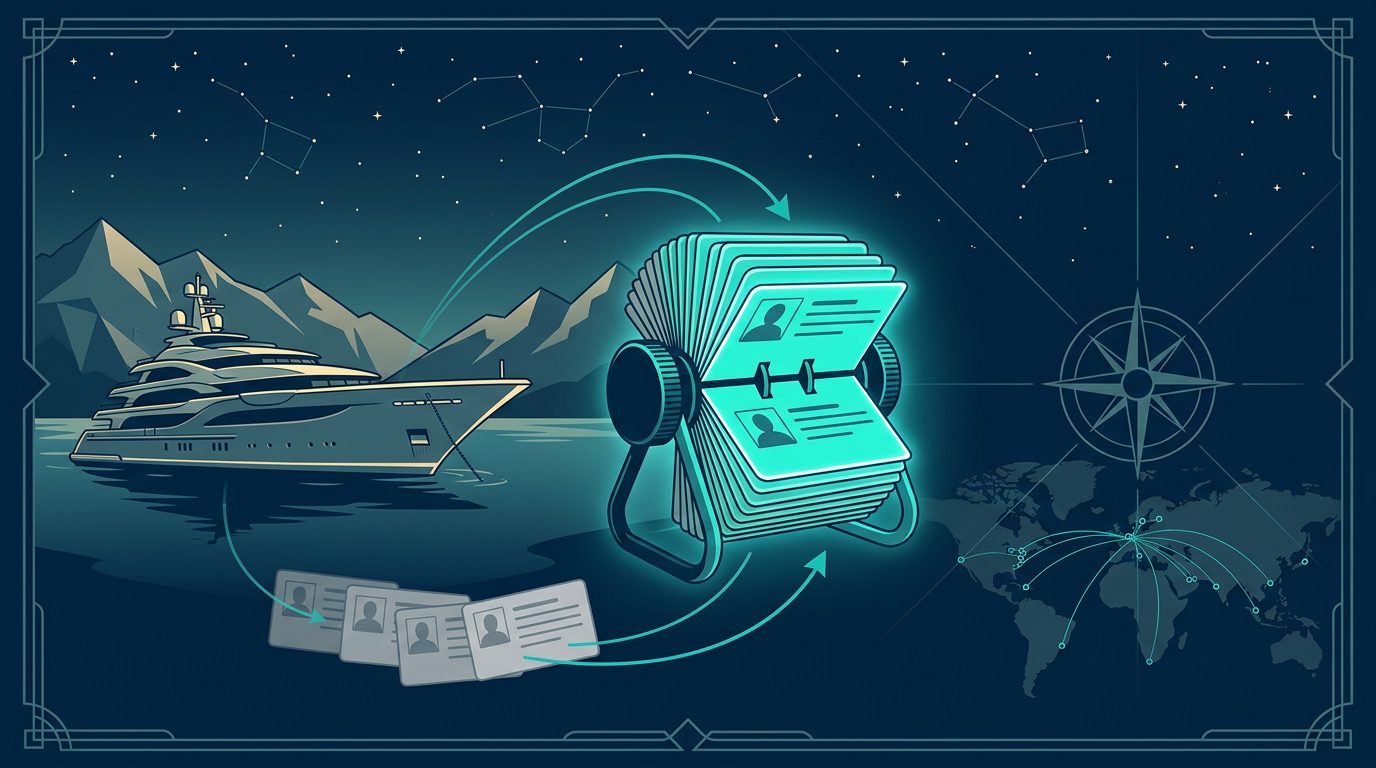
Small team · Over 5,000 CRM contacts · 7 opportunity areas identified · Global charter representation
Seven opportunity areas mapped across a global charter operation with over 5,000 CRM contacts, sequenced into a three-phase adoption plan, with return client re-engagement carrying a 10 to 20 percent dormant lead reactivation potential inside the existing contact base.
Read full engagement
191 social posts published or booked in four weeks · 41 posts booked ahead · 11 channels on Instagram, Facebook and LinkedIn · Four brands from one marketing office · Median first draft under 15 minutes
In its first four weeks the assistant published 150 social posts and booked 41 more ahead, across 11 channels for four brands. A person approves each draft before a post is booked or a campaign is built.
Read full engagementThe Opportunity
In the UK the code and the flag are the frame. The revised REG Yacht Code and the MCA's MGN 669 already read the AI annex sitting inside the SMS, and the MCA's cyber inspection line reaches IT-connected OT, which is where an AI feature bundled into a plotter, thruster control or engine monitor eventually lands. The London market's own move is documented: the LMA's example AI question sets exist today for underwriters and PI insurers, and 93 percent of surveyed Lloyd's managing agents run or are building formal AI governance frameworks. What the captain needs is one written position that reads to flag, class, insurers and the master in charge, and the AI annex, the approved-tools register and the named review before machine-drafted material goes anywhere give the same document to each of them.
Owner and guest letters
The arrival letter a junior officer once polished in ChatGPT gets drafted against an approved tool, with a review step before it reaches the owner or a guest and the itinerary kept off any unvetted server.
Near-miss and incident reports
The near-miss write-up and the incident record get a fast first draft that the master reads and counter-signs before it enters the SMS or reaches flag.
ISM and port paperwork
Port clearance forms and routine ISM document updates get assembled in minutes, with the officer checking each entry against the vessel's own records before filing.
Passage and handover notes
Watch handover notes and passage summaries get drafted off-watch, with the officer confirming the detail before it stands.
Rosters and rest-hour context
Roster drafts and the supporting notes behind hours-of-rest records get prepared for review, with the master confirming the record is true before signing, since the counter-signature stays his.
Insurance renewal answers
The cyber-and-controls section of the renewal questionnaire gets a first draft from the vessel's written AI position, reviewed by the captain before it goes to the broker.
These are the workflows the prompt library and the crew training day stand up, under the standard the AI annex to the SMS sets.
Where to start
The whole crew to one standard in a yard period or alongside, certificates verifiable at southernsky.ai/verify.
The position moves when the tools and the rules move.
The outputs are governance artifacts, drafted for review and adoption inside your own organisation; where legal advice is needed, it belongs with qualified counsel.
Reading

June 2026
What the frameworks say, how far they reach, and what organisations can do now.
September 5, 2026
What an AI agent is, why one is usually a team of them working to an org chart, what a marketing build looks like inside, and the parts of the job that stay with you.

August 30, 2026
Why a language model reaches for the most ordinary answer, how computer vision does the same thing with pixels, and why bias comes out of that mechanism rather than being added on top.

Written from inside your world
Kristina Agustin
Founder & Principal Digital Navigator, Southern Sky AI
20+ years in international superyacht and maritime operations. Legally trained (LLB, Graduate Diploma of Legal Practice). AI educator and consultant. ATSE Elevate Scholar 2026.
Questions
Weekly insights on AI in maritime, delivered every Sunday.
Want to see how AI reads your website? Run the AI Readability Check.
Prefer to talk it through first? Book an introductory conversation.