Industries · Shipyards & Boat Manufacturing

AI for US shipyards and boat builders.

Retail closed 2025 down, the trades stay scarce against the Navy's own 174,000-worker count, and CMMC clauses now arrive in new defence contracts. What AI is already doing in yards and plants like yours, and the safest way to start.

The board says three hulls at fit-out and one on survey. The trades list says two short, again. Nine out of ten marine businesses now report the same shortage, and half are already losing revenue to it.

The record so far

221obligations

tracked across 25 jurisdictions

  • Every founding document reviewed by the legally trained founder before delivery.

  • Documents usually within two business days.

  • Training certificates independently verifiable at southernsky.ai/verify.

Start Here

Read your yard's position in about five minutes. Twenty plain questions in, four readings back: the AI risks as they reach your business, the regulations that already apply to you, the cost of leaving use unmanaged, and the moves that matter most, ranked from the top. Defence and export exposure changes your answers, and the reading accounts for it.

Get your baseline

Where this sits for you

The pressures in your world

Meanwhile the office found its own help: a tender drafted with a chatbot, an estimate sanity-checked against one, a defect photo sent to a tool no one signed off. Each of those got someone home by five. Each one also carried yard information somewhere your defence and export contracts did not contemplate, and those clauses were written as if it could never happen. Two jobs sit in front of most yards now: capture what the senior tradesmen know before retirement takes it, and protect what the contracts say must never leave. Both start in the same place, a written position on how this yard uses AI. Reading yours takes about five minutes.

  1. 174,000 workers this decade

    US

    The Navy's 45-day shipbuilding review counts 174,000 new workers needed across the industrial base over the next decade, average yard attrition runs 20 to 22 percent and passes 30 percent in critical trades, and production builders report facility capacity to spare against the sanders they cannot find.

  2. CMMC is a pass-fail gate

    US

    CMMC, the Department of Defense's cybersecurity certification for contractors, took final effect on 10 November 2025: clauses appear in new solicitations now, enforcement phases to 2028, most manufacturers touching Controlled Unclassified Information need Level 2, and an uncertified yard is ineligible for award.

  3. Product AI sets the public agenda

    US

    Brunswick returned to CES in January 2026 with production-ready autonomous docking on a Sea Ray and an AI co-pilot helm simulator. AI shipped in the product reaches the warranty desk and the liability file ahead of the brochure.

  4. Soft retail, hard line-rate calls

    US

    NMMA estimates 2025 new powerboat retail down 8 to 10 percent to roughly 215,000 to 225,000 units, with 2026 expected on par to slightly up, and the quarterly line-rate call decides which trades stay through the trough.

  5. Tariffs run in both directions

    US

    Steel and aluminium import tariffs inflate hull-material cost, with builders warehousing aluminium against increases, and the 2018 EU 25 percent tax on American boats cut US boat exports to the EU by 22 percent in a year, about 70 million dollars.

  6. The export hull carries EU paperwork

    US

    A hull bound for an EU owner travels under the Recreational Craft Directive, and from December 2026 the revised EU Product Liability Directive treats the software aboard as a product, so the AI-features documentation pack becomes the exporter's evidence file.

  7. The trades are short and the knowledge is retiring

    Nine out of ten marine businesses report concern about the skilled-labour shortage and 52.1 percent already report direct revenue loss from it. The deeper cost sits behind the headcount: the methods a retiring shipwright carries were never written down, so a departure removes a pair of hands and some of the yard's memory of how the job is done. Capturing that knowledge is the highest-return AI project a heritage yard holds, once the data boundary exists to do it safely.

  8. Defence yards hire from the same pool

    Austal alone is seeking about a thousand additional staff, and the wider precinct build-outs target thousands more. Every welder, fabricator and marine electrician a defence prime signs is one a private yard loses or pays more to keep, and the choice bites hardest in a soft quarter.

  9. Refit quotes meet reality when the boat opens

    Across the industry, refit projects routinely run 30 to 50 percent over originally quoted scope, driven by what opening the vessel reveals and by thin specification. Variations recover margin and cost client relationships in the same motion. The estimator's spreadsheet is the highest-leverage document in the building, and it is usually one person's.

  10. Long-lead parts idle bays the schedule already sold

    Engines, gensets and electronics still arrive on quarters-long lead times, and 42.1 percent of marine businesses carry project delays and backlogs. A part that misses the haul-out window can strand a vessel on hardstand for weeks, with the bay booked behind it.

  11. The WHS bar keeps rising

    The welding-fume exposure standard was cut from 5 to 1 mg/m³ in January 2024, and enclosed-hull welding can exceed the new limits several times over without engineered ventilation. A tightening arrives as monitoring, documentation, hot-works permits and training records, administered by the same office that runs the schedule.

  12. Contract data rules written before AI existed

    Defence-security obligations, AUKUS-grade controls and export certification lanes assume information stays where the contract put it. One contract-controlled specification pasted into a public chatbot is a conversation with Defence nobody wants to have. A written classification rule, briefed to the office and the shed, is the single control that holds that line.

The Opportunity

What AI is already doing

Office-side AI reaches a US yard before the floor does, through staff using public tools rather than an IT project: tender responses drafted under a classification rule that keeps contract-controlled specifications out of public tools, an estimator sanity-checking a fixed-price quote, procurement correspondence, a foreman's defect photograph read for a second opinion against the surveyor's sign-off.

The highest-return project in a heritage yard is knowledge capture. Attrition in the critical trades runs past 30 percent, and the methods your senior builders carry deserve capture under proper controls before the next resignation letter: run once the classification rule names what must never enter an external tool, the same boundary discipline a CMMC assessment already assumes.


Tender and bid drafting

Staff draft tender responses with a chatbot, under a classification rule that keeps contract-controlled specifications out of public tools and a named reviewer before submission.

Estimating support

An estimator sanity-checks a fixed-price quote and a spec-change impact against AI, with a checkpoint between the tool's output and the priced commitment.

Defect second-opinion

A foreman photographs a defect for a second read from a tool, checked against the surveyor's sign-off.

Procurement email

Supplier chase-ups and procurement correspondence are drafted with AI and reviewed before they go out.

Knowledge capture

The methods a retiring shipwright carries get captured with AI, the highest-return project in a heritage yard, run only once the classification rule names what must not enter an external tool.

WHS and training records

Toolbox-talk notes and training records are drafted with AI and checked before they enter the record.

These are the workflows the prompt library and training stand up, under the standard the classification rule, approved-tools register and human-checkpoint map set, the same artefacts the security-clearance posture your contracts assume.

Where to start

Where to start, and where it leads.

  1. Baseline

    See what AI could do for your organisation. The AI Baseline Report takes twenty questions and about five minutes, and reads back the use cases returning hours in organisations like yours, the rules that already apply to you, and the moves that matter most, ranked from the top.

  2. Blueprint

    For yards with defence or export exposure: risk classification mapped to contract obligations, the classification rule written and briefed, deployment sequencing for knowledge capture and estimating support.

  3. Governance Essentials

    For yards without defence exposure: the AI use policy, approved-tools register and training pathway drafted for adoption inside your organisation, with a prompt library that starts the office's first governed workflow, 90 days of keep-current and team education, a recorded briefing, a 30-minute walkthrough call and 30 days of email support. USD $690 founding, then USD $990.

  4. Training day

    The office and the shed to one standard, toolbox-talk format, verifiable certificates.

  5. Keep-current

    The position holds as defence expectations and EU product liability rules move.

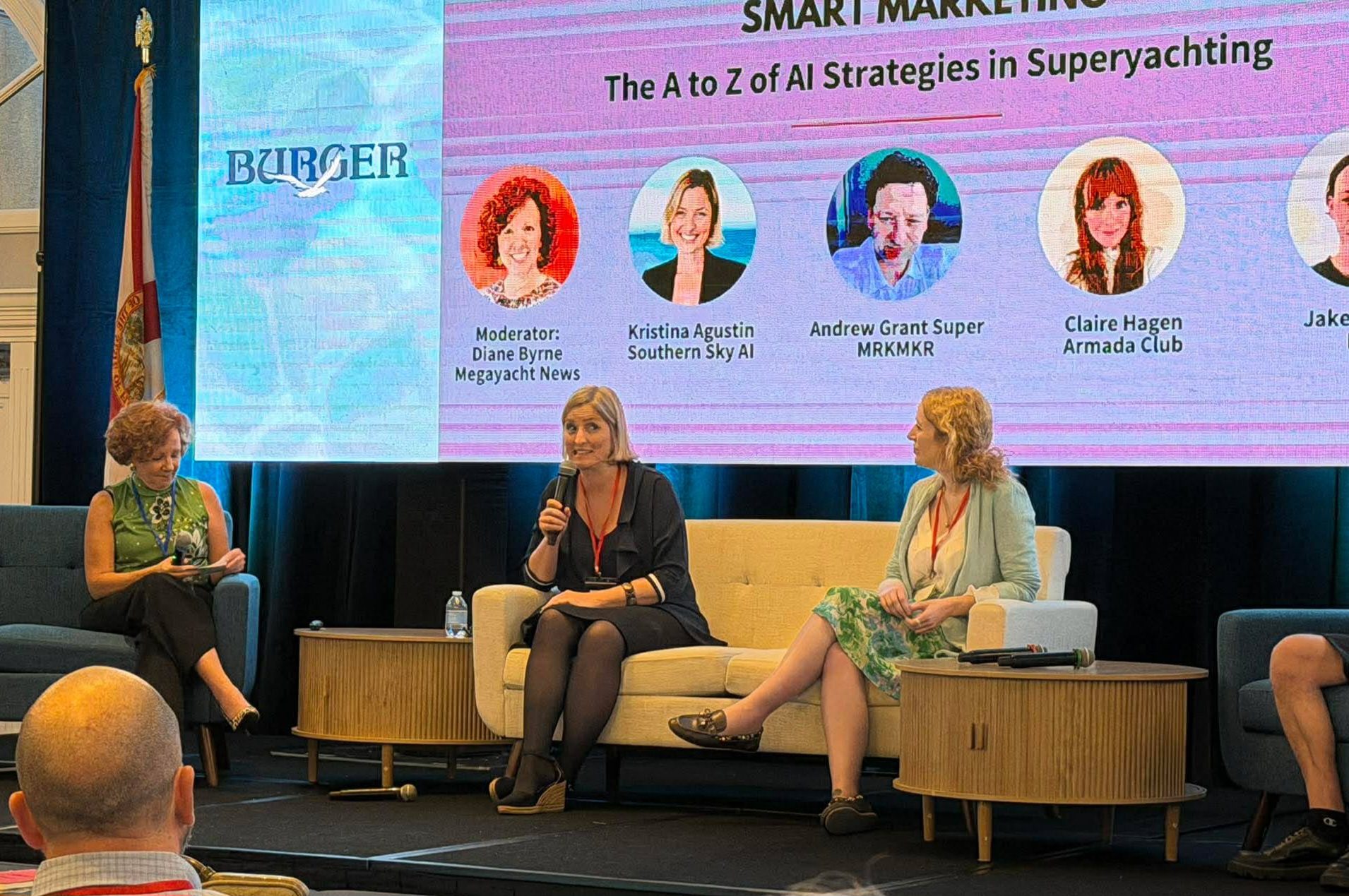
Kristina Agustin, Founder and Principal of Southern Sky AI

Written from inside your world

Kristina Agustin

Founder & Principal Digital Navigator, Southern Sky AI

20+ years in international superyacht and maritime operations. Legally trained (LLB, Graduate Diploma of Legal Practice). AI educator and consultant. ATSE Elevate Scholar 2026.

About Southern Sky AI

Questions

Questions we hear

Inside the same boundary discipline CMMC already asks of you. Controlled Unclassified Information carries handling conditions that one paste into a public tool can breach, and the certification clock is running: clauses in new contracts now, full enforcement by 2028. The first artefact we draft is a classification rule, what must not enter an external tool, written down and briefed to the office and the shop floor. It reads as a natural extension of your NIST 800-171 control narrative.

Start with where you stand.

The AI Baseline Report reads your position in about five minutes, and your answers pre-fill everything that follows.

Run the Baseline

Already know where you stand? Governance Essentials puts your position in writing inside 30 days.