

Perspective
An AI Agent Acts For You
September 5, 2026
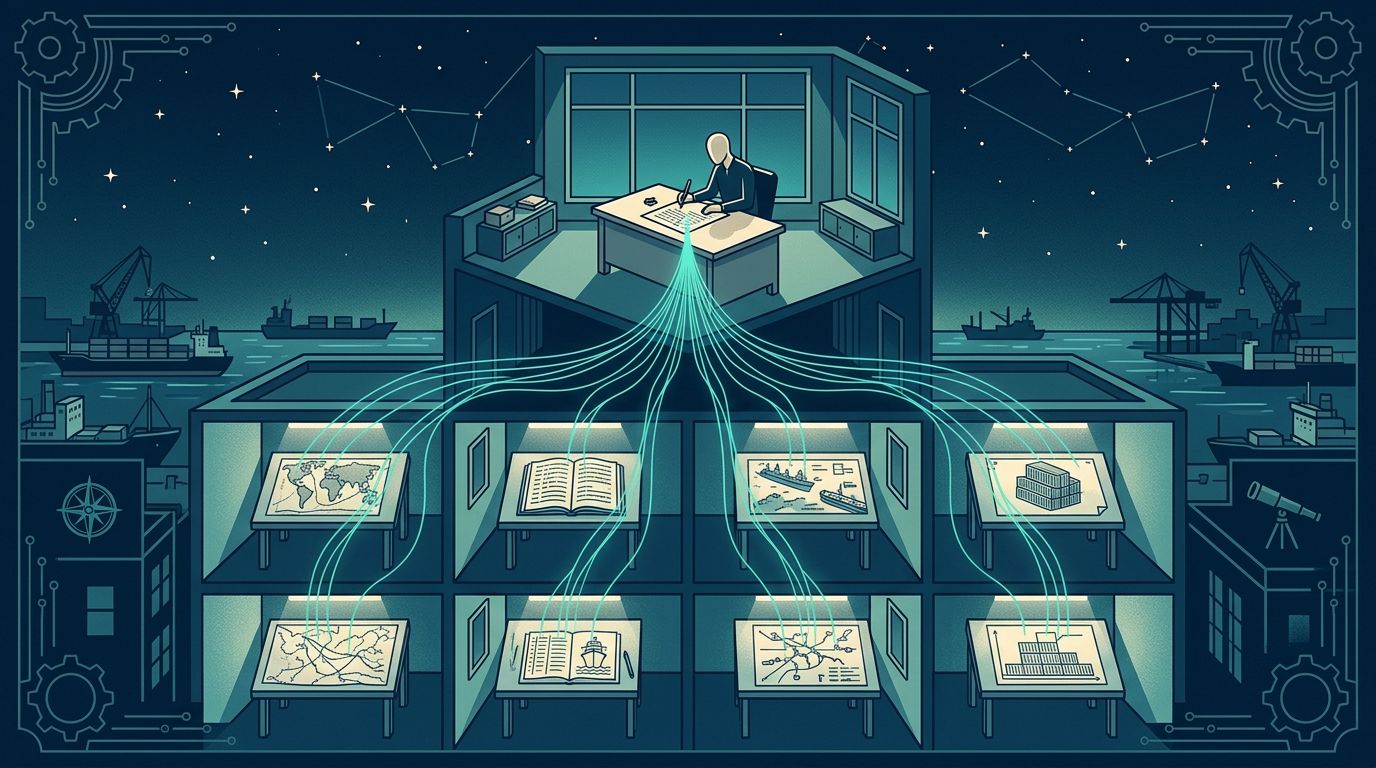
What an AI agent is, why one is usually a team of them working to an org chart, what a marketing build looks like inside, and the parts of the job that stay with you.

Industries · Shipyards & Boat Manufacturing
The board says three hulls at fit-out and one on survey. The trades list says two short, again. Nine out of ten marine businesses now report the same shortage, and half are already losing revenue to it.
The page you are reading is universal. Pick your region to see the regulators, cases and pressures that reach your operation.
Where are you based?
The record so far
tracked across 25 jurisdictions
Every founding document reviewed by the legally trained founder before delivery.
Documents usually within two business days.
Training certificates independently verifiable at southernsky.ai/verify.
Where this sits for you
Meanwhile the office found its own help: a tender drafted with a chatbot, an estimate sanity-checked against one, a defect photo sent to a tool no one signed off. Each of those got someone home by five. Each one also carried yard information somewhere your defence and export contracts did not contemplate, and those clauses were written as if it could never happen. Two jobs sit in front of most yards now: capture what the senior tradesmen know before retirement takes it, and protect what the contracts say must never leave. Both start in the same place, a written position on how this yard uses AI. Reading yours takes about five minutes.
Nine out of ten marine businesses report concern about the skilled-labour shortage and 52.1 percent already report direct revenue loss from it. The deeper cost sits behind the headcount: the methods a retiring shipwright carries were never written down, so a departure removes a pair of hands and some of the yard's memory of how the job is done. Capturing that knowledge is the highest-return AI project a heritage yard holds, once the data boundary exists to do it safely.
Austal alone is seeking about a thousand additional staff, and the wider precinct build-outs target thousands more. Every welder, fabricator and marine electrician a defence prime signs is one a private yard loses or pays more to keep, and the choice bites hardest in a soft quarter.
Across the industry, refit projects routinely run 30 to 50 percent over originally quoted scope, driven by what opening the vessel reveals and by thin specification. Variations recover margin and cost client relationships in the same motion. The estimator's spreadsheet is the highest-leverage document in the building, and it is usually one person's.
Documented Work

70+ year heritage · Government and defence supply chain · 24-month roadmap · Essential Eight baseline assessed
A structured assessment across 5 stakeholders and 8 operational systems produced 6 prioritised opportunities, a phased 24-month roadmap, and a 90-day action plan with defined success measures, including an Essential Eight cybersecurity baseline aligned to government and defence tender requirements.
Read full engagement
191 social posts published or booked in four weeks · 41 posts booked ahead · 11 channels on Instagram, Facebook and LinkedIn · Four brands from one marketing office · Median first draft under 15 minutes
In its first four weeks the assistant published 150 social posts and booked 41 more ahead, across 11 channels for four brands. A person approves each draft before a post is booked or a campaign is built.
Read full engagementThe Opportunity
Tender and bid drafting
Staff draft tender responses with a chatbot, under a classification rule that keeps contract-controlled specifications out of public tools and a named reviewer before submission.
Estimating support
An estimator sanity-checks a fixed-price quote and a spec-change impact against AI, with a checkpoint between the tool's output and the priced commitment.
Defect second-opinion
A foreman photographs a defect for a second read from a tool, checked against the surveyor's sign-off.
Procurement email
Supplier chase-ups and procurement correspondence are drafted with AI and reviewed before they go out.
Knowledge capture
The methods a retiring shipwright carries get captured with AI, the highest-return project in a heritage yard, run only once the classification rule names what must not enter an external tool.
WHS and training records
Toolbox-talk notes and training records are drafted with AI and checked before they enter the record.
These are the workflows the prompt library and training stand up, under the standard the classification rule, approved-tools register and human-checkpoint map set, the same artefacts a DISP review or an export file already assumes.
Where to start
For yards with defence or export exposure: risk classification mapped to contract obligations, the classification rule written and briefed, deployment sequencing for knowledge capture and estimating support.
The office and the shed to one standard, toolbox-talk format, verifiable certificates.
The position holds as defence expectations and EU product liability rules move.
Reading

2026
The EU AI Act and adjacent regimes reaching EU marine operators.
2026
Federal and state instruments reaching US marine operators.
September 5, 2026
What an AI agent is, why one is usually a team of them working to an org chart, what a marketing build looks like inside, and the parts of the job that stay with you.

Written from inside your world
Kristina Agustin
Founder & Principal Digital Navigator, Southern Sky AI
20+ years in international superyacht and maritime operations. Legally trained (LLB, Graduate Diploma of Legal Practice). AI educator and consultant. ATSE Elevate Scholar 2026.
Questions
Weekly insights on AI in maritime, delivered every Sunday.
Want to see how AI reads your website? Run the AI Readability Check.
Prefer to talk it through first? Book an introductory conversation.