Industries · Passenger Vessels

AI for US passenger vessel operators.

The Certificate of Inspection names your route, your passenger count and your crewing, and since the fire safety rule the drill log and the training record carry as much weight as the extinguisher tag. What AI is already doing across operations like yours, and the safest way to start.

The season sets your calendar and the SMS sets your evenings, and AI has arrived across the business in the middle of both: a supervisor polishing an incident report in ChatGPT, marketing drafting the campaign with it, the booking platform answering guests about refunds through an AI agent you never configured. Each use makes a busy day easier. This page sets out what that means for a passenger vessel operator: the pressures, what the tools can do for you, and the first step.

Prefer to talk it through first? .

Superyacht AustraliaAsia Pacific Superyacht AssociationInternational Association of Privacy ProfessionalsMarina Industries Association MemberThe Superyacht SocietyWomen's International Shipping & Trading Association

The record so far

221obligations

tracked across 25 jurisdictions

  • Every founding document reviewed by the legally trained founder before delivery.

  • Documents usually within two business days.

  • Training certificates independently verifiable at southernsky.ai/verify.

71%

of tourism operators reporting AI already in use across parts of the business.

15-30%

OTA commission on every booking before processing and cancellation costs.

Start Here

Read your position in about five minutes. Twenty plain questions in, four readings back: the AI risks as they reach your business, the regulations that already apply to you, the cost of leaving that use unmanaged, and the moves that matter most, ranked from the top.

Get your baseline

Where this sits for you

The pressures in your world

Those same uses form a pattern without an owner: guest records moving through tools that were never procured, safety-adjacent documents drafted by systems that have never stood on your deck, and a brand that carries the story if one of them gets it wrong. You already run the discipline this needs. Your safety management system names who checks what before the vessel leaves the berth, and AI governance applies the same discipline to a new hazard class, so the productivity your teams found stays and the practice becomes reviewable.

Inspected under Subchapter T, K or H

US

The US Coast Guard, the federal maritime safety regulator, inspects domestic passenger vessels under three subchapters of 46 CFR, and the Certificate of Inspection names route, passenger count, crewing and conditions, with the annual inspection testing the vessel against each line of it.

The fire safety rule changed the paperwork

US

Since March 2022 the fire safety interim rule has required fire detection in unattended spaces, logged egress drills and crew firefighting training on Subchapter T and K vessels, so the drill log and the training record now sit beside the extinguisher tag at inspection.

Seaman's manslaughter reaches the wheelhouse

US

The federal seaman's manslaughter statute, 18 U.S.C. §1115, reaches masters and operators on simple negligence, and in March 2026 the Ninth Circuit upheld the Conception captain's conviction on that standard.

The Coast Guard scores your vessel with AI

US

The Coast Guard's published AI inventory includes a system that assigns each small passenger vessel a safety risk score to set inspection frequency and depth, so the paperwork you file already feeds the regulator's model.

A voluntary SMS still gets read

US

US domestic passenger vessels carry no general safety management system mandate, the proposed rule has sat unpublished since the 2021 advance notice, and a voluntary SMS still becomes one of the first documents counsel requests in a limitation action.

The cybersecurity rule is live

US

The maritime cybersecurity rule, 33 CFR Part 101 Subpart F, took effect in July 2025: MTSA-regulated operators designate a Cybersecurity Officer, train personnel and complete assessments by July 2027, and larger ferry and dinner-boat operators sit in scope.

The Opportunity

What AI is already doing

AI reached US passenger operations through the booking stack and the office rather than through a decision. FareHarbor's agent answers guests about refunds, inclusions and weather policy from live availability, crews draft review replies and campaign copy in public tools, and FareHarbor's own operator survey lists standard operating procedures, agreements and training materials among the uses.

What those tools promise, you promise. Consumer protection law, federal and state, reads an agent's answer as the operator's conduct, and the safety document a prosecutor reads is the same document a chatbot may have helped draft. The workflows stay; a named person checks what reaches a guest, the crew or the record.


  1. Marketing and reviews

    Crews draft campaign copy and guest-review replies in ChatGPT and Canva, turning an evening job into a short one, and a named person reads each post before it goes out in the operator's name.

  2. Guest answers on the booking stack

    Platform agents such as FareHarbor Agent and Rezdy assistants answer guests about refunds, inclusions and weather policy from live availability, so the register names who owns and checks what those agents say.

  3. Incident reports and toolbox notes

    Supervisors polish incident reports and toolbox-talk notes with a chatbot, and FareHarbor's own survey lists SOPs, agreements and training materials among operator uses, so a named person verifies the wording before it reaches crew or the regulator.

  4. Grant and funding writing

    Owners draft grant applications and funding submissions with AI, and the operator confirms the figures and the claims before lodging.

  5. Dynamic pricing

    Rezdy's pricing engine proposes fares against demand, and a person signs the rate card before it goes live.

  6. These are the workflows the prompt library and training stand up, under the standard the AI use policy, approved-tools register and verification checkpoints set.

Where to start

Where to start, and where it leads.

  1. Training day

    Nine departments to one shared standard in a day, with verified certificates.

  2. Baseline

    See what AI could do for your organisation. The AI Baseline Report takes twenty questions and about five minutes, and reads back the use cases returning hours in organisations like yours, the rules that already apply to you, and the moves that matter most, ranked from the top.

  3. Governance Essentials

    The working start across the departments: the AI use policy, approved-tools register and verification checkpoints drafted for adoption inside your organisation, with a prompt library that starts the first governed workflow, 90 days of team education for every department in the client portal, a recorded briefing, a 30-minute walkthrough call and 30 days of email support. USD $690 founding, then USD $990.

  4. Blueprint

    The readiness review, risk classification and policy framework for the multi-department operator.

  5. Keep-current and the Navigator Portal

    The relationship that holds as tools and rules move between seasons.

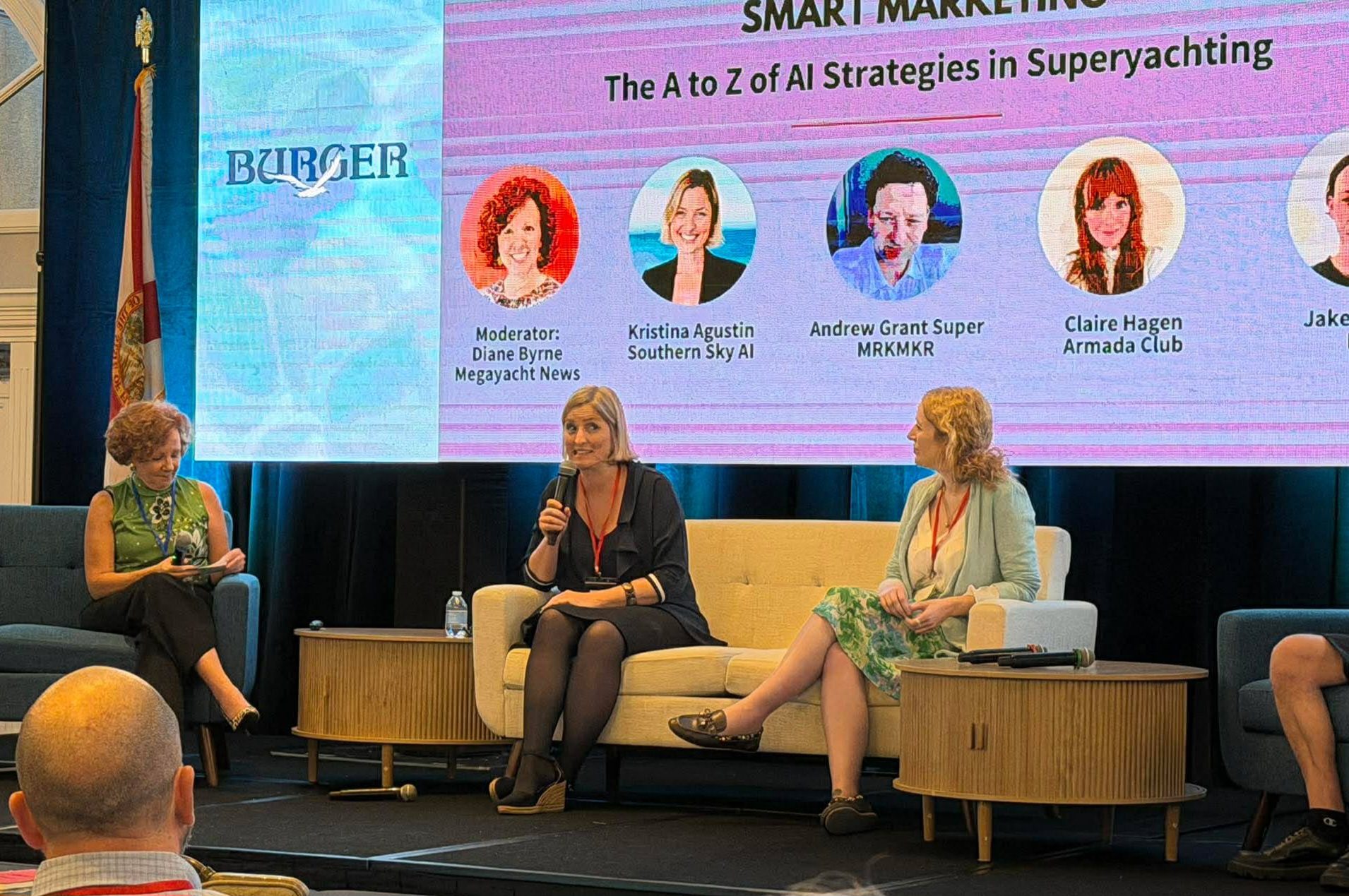
Kristina Agustin, Founder and Principal of Southern Sky AI

Written from inside your world

Kristina Agustin

Founder & Principal Digital Navigator, Southern Sky AI

20+ years in international superyacht and maritime operations. Legally trained (LLB, Graduate Diploma of Legal Practice). AI educator and consultant. ATSE Elevate Scholar 2026.

About Southern Sky AI

Questions

Questions we hear

The discipline travels with the flag. The jurisdictions we serve centre on the same artefact: a safety document you would defend, and a named person who checks the machine's output before it reaches crew, guests or the record. Kristina is legally trained and maritime-fluent, and works with US operators remotely across time zones. Where US legal advice is needed, it belongs with admiralty counsel.

Start with where you stand.

The AI Baseline Report reads your position in about five minutes, and your answers pre-fill everything that follows.

Run the Baseline

Already know where you stand? Governance Essentials puts your position in writing inside 30 days.