





Industries · Marinas & Boatyards

AI for Australian marinas and boatyards.

Storm season sets the calendar, the waitlist runs years, and the northern renewal arrives with a cyclone excess attached. What AI is already doing in the berth office, the Australian rules that reach it, and the safest way to start.

The berth sheet is full, the waitlist runs years, and the same small office carries all of it: rate letters, licence renewals, contractor inductions, the debtor list, the board pack. The insurance renewal weighs heavier each year, and the questionnaire now asks about cyber controls and data handling alongside the cyclone plan. Somewhere in that week, AI arrived.

The record so far

221obligations

tracked across 25 jurisdictions

  • Every founding document reviewed by the legally trained founder before delivery.

  • Documents usually within two business days.

  • Training certificates independently verifiable at southernsky.ai/verify.

Start Here

Read your marina's position in about five minutes. Twenty plain questions in, four readings back: the AI risks as they reach your marina, the regulations that already apply to you, the cost of leaving that use unmanaged, and the moves that matter most, ranked.

Get your baseline

Where this sits for you

The pressures in your world

A rate letter drafted in ChatGPT, Copilot switched on inside Microsoft 365 without anyone deciding it, a camera system with detection features nobody has read the terms of. Your berth holders trust you with names, addresses, vessel values and payment details, and that trust is the asset the whole business rests on. There is a version of this where the office keeps its speed, the tools carry rules the way the fuel wharf carries rules, and you can tell the board and the insurer where you stand. It starts with knowing your position.

  1. The insurance renewal weighs heavier every year

    AUS

    Northern-Australian marina premiums have risen by more than 300 percent, cyclone excesses have reached $500,000 to $1,000,000, and marine was left out of the federal Cyclone Reinsurance Pool. A Treasury-commissioned review found large marinas unable to place all of their risk. The questionnaire itself is changing too: underwriters now ask about cyber controls and data handling in growing detail, and questions about AI use are following the same path.

  2. The manager's chair is the hardest to fill

    AUS

    The marina manager position has been the role that keeps arriving as the hardest to fill in the sector's own salary survey, senior vacancies take months, and 52.1 percent of marine businesses already report direct revenue loss from workforce gaps. Succession planning sits near the top of the sector's worry list. The other pressures on this page fall to a small office that cannot be replaced if it burns out.

  3. Storm season rewrites the calendar every year

    AUS

    Jasper emptied Port Douglas Marina, and Alfred left roughly $1.7 billion in insured damage behind it. Storm season brings the haul-out surge, the evacuation plan, the berth-holder communications, and afterwards the liability question of who ordered what and when. Southern marinas trade cyclones for east-coast lows and debris events, and the preparation cycle runs annually either way.

  4. The seasons behind the premiums

    AUS

    Cyclone Jasper emptied Port Douglas Marina entirely and drew claims of about 95 million dollars, Alfred ran to about 1.7 billion, and marine was excluded from the federal Cyclone Reinsurance Pool. A Treasury-commissioned review found two large marinas unable to place all of their risk. That arithmetic is what the northern renewal now carries.

  5. The Privacy Act reached the berth ledger

    AUS

    The berth ledger holds names, home addresses, vessel values and payment details, and the Privacy Act, Australia's national privacy law, now carries a statutory tort for serious invasions of privacy, an infringement-notice regime, and transparency obligations around automated decisions on the way. The written rules for how that ledger moves through new tools are the marina's to hold.

  6. The trades you cannot hire

    AUS

    The BIA, the boating industry's national association, found 90.1 percent of marine businesses concerned about the lack of skilled labour in its 2026 survey, with 52.1 percent already losing revenue to workforce gaps and shipwrights the hardest trade to find. The office carries the hours the vacancies leave behind, which is where drafting help returns the hours.

  7. Full berths, long waitlists, software from another era

    Australian marinas average 85.4 percent occupancy with waitlists measured in years, so the commercial question is yield and visitor churn. The systems carrying that question are old: the marina management platform on one side, Xero on the other, and a reconciliation between them that someone re-keys by hand. Berth-holder records, licence data and the debtor list sit scattered across five or six systems that meet only in your head.

  8. Forty contractors through the gate, ten staff to manage them

    The average facility runs about forty contractors against ten employees, so the compliance load is mostly about other people's workers: inductions, SWMS for work at height and over water, insurance certificate currency, and the berth-holder's own tradesperson walking the dock unannounced. Those interfaces are yours to document and defend.

Documented Work

From the Log Book

AI Training

3 role-based workshop days, designed from a 12-department audit · 18 people certified, from maintenance and marine to finance and the executive team · Every participant left with a working AI setup and a reusable Skill built on a real task from their own role · Weeks later, reported publicly by the client: the team using AI more, sharing wins, and a real shift in the day to day

Eighteen people, ten departments, one shared standard for how AI gets used across the organisation.

A twelve-department audit produced three role-based workshop days that certified eighteen people across ten departments, with the CHART quality method and the data rule embedded across the team and every certificate carrying a public verification page.

Read full engagement
AI Training

One-day executive foundation session, delivered one-on-one, designed around a tightly controlled corporate IT environment where every tool runs in the browser · A monthly management accounting and insurer reporting workflow, sixteen reports each month, run end to end through the CHART quality method and captured as a reusable skill · A take-home toolkit and a short explainer video, so everything built on the day stays usable after it

A regulated insurance business, and AI capability built one executive at a time.

A one-day, one-on-one foundation session with a senior executive in the marine insurance sector: a governed AI platform with a commercial data agreement behind it, a working environment built from the executive's own context, and a monthly reporting workflow of sixteen insurer reports run end to end and captured as a reusable skill.

Read full engagement

The Opportunity

What AI is already doing

Australian marinas run near capacity: 85.4 percent average occupancy with waitlists measured in years, where operators in other markets talk about filling empty berths. So the hours these workflows return go to yield, the waitlist and the board pack rather than to chasing occupancy. The workflows themselves stay as the section below describes them: drafted in minutes, checked by a person before anything goes out, and the discipline arrives the way a site rule does, briefed once to the whole team before the season builds.

Berth enquiries and rate letters

A broker's waitlist enquiry and the monthly rate-letter run for licence renewals get drafted in minutes, with the manager checking the figures and the licence terms before signing.

Contractor induction packs

The induction pack and SWMS notes for a shipwright crew starting a hardstand job get assembled from the marina's own site rules, with a person confirming the insurance certificates are current before the gate opens.

Debtor follow-ups

The debtor list out of the marina management system turns into chase letters pitched at the right tone, drafted for the office to approve line by line before they reach a berth-holder.

The monthly board pack

Occupancy, revenue, debtors and incidents come together into the three-page board pack in a fraction of the usual time, with the manager checking the numbers against the source system before the board reads them.

Storm-season communications

Berth-holder notices and the incident record around a weather event get drafted quickly under pressure, with the duty manager confirming the account of who ordered what and when before it is filed.

The insurance renewal file

The cyber-and-data section of the renewal questionnaire gets a first draft from the marina's written position, with the manager reviewing the answers before they go to the broker.

These are the workflows the prompt library and the training day stand up, under the standard the written policy and approved-tools register set.

Where to start

Where to start, and where it leads.

  1. Baseline

    See what AI could do for your organisation. The AI Baseline Report takes twenty questions and about five minutes, and reads back the use cases returning hours in organisations like yours, the rules that already apply to you, and the moves that matter most, ranked from the top.

  2. Governance Essentials

    The working start for the marina office: a guided interview reads your operation once, and back comes a prompt library that starts your first governed workflow, 90 days of team education for the office, and the written AI policy, approved-tools register and risk read a manager can put in front of a board, an underwriter or a head office, with a recorded briefing, a 30-minute walkthrough call and 30 days of email support. USD $690 for the founding twenty places, then USD $990.

  3. Training day

    The office and the dock team to one standard, with certificates verifiable at southernsky.ai/verify.

  4. Keep-current subscription

    The position stays true as the tools change.

  5. The Blueprint

    For marina groups and multi-site operators wanting done-with-you depth.

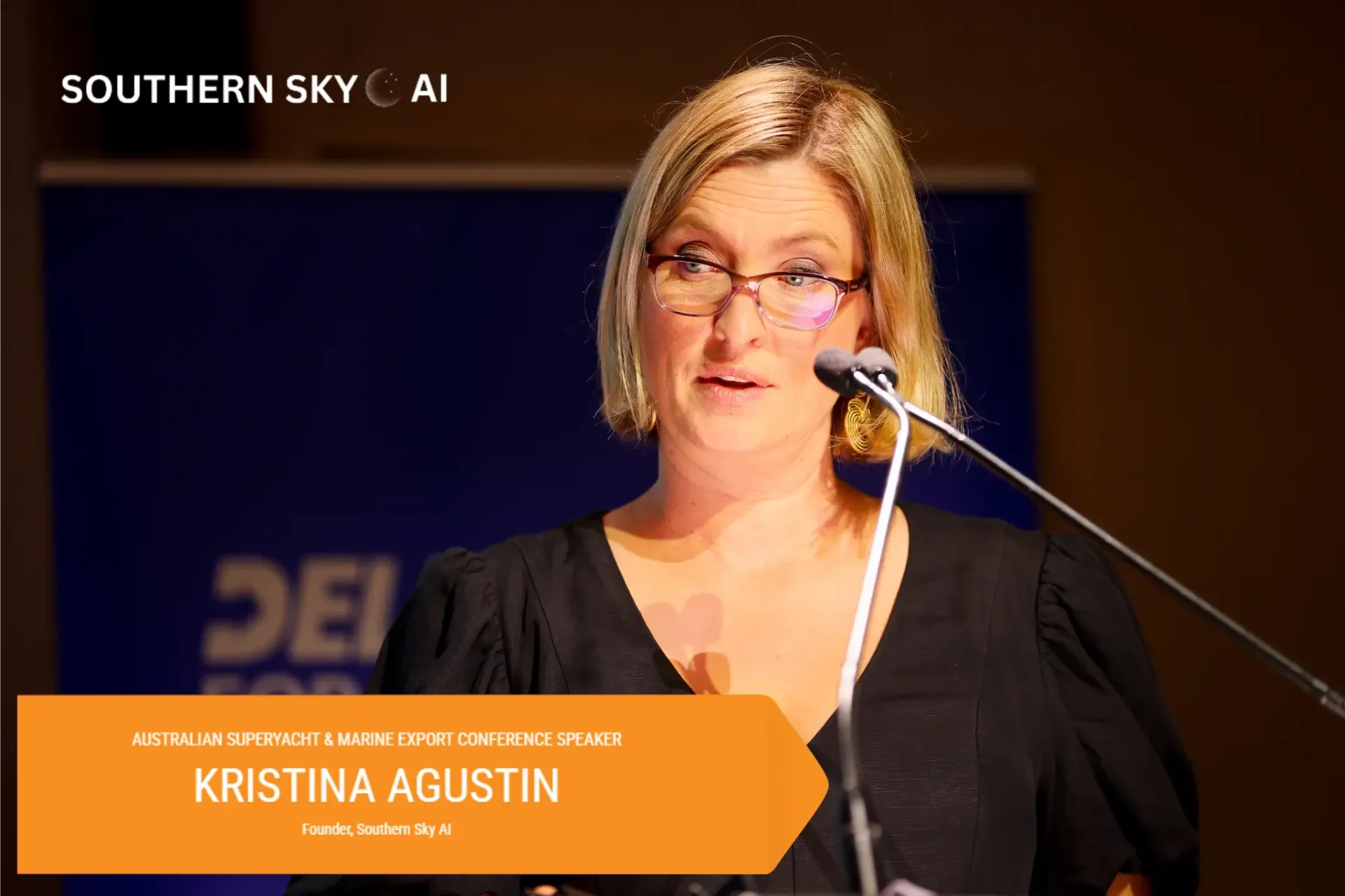
Kristina Agustin, Founder and Principal of Southern Sky AI

Written from inside your world

Kristina Agustin

Founder & Principal Digital Navigator, Southern Sky AI

20+ years in international superyacht and maritime operations. Legally trained (LLB, Graduate Diploma of Legal Practice). AI educator and consultant. ATSE Elevate Scholar 2026.

About Southern Sky AI

Questions

Questions we hear

Applicability turns on the business, and a ruling on your exact position belongs with qualified counsel. What does not change: the berth ledger holds names, home addresses, vessel values and payment details, the amendments added a statutory tort for serious invasions of privacy, and transparency obligations around automated decisions are arriving. The written policy and approved-tools register are the discipline that keeps that ledger out of unapproved tools, drafted for a four-to-eight person office.

Start with where you stand.

The AI Baseline Report reads your position in about five minutes, and your answers pre-fill everything that follows.

Run the Baseline

Already know where you stand? Governance Essentials puts your position in writing inside 30 days.