Industries · Government & Registries

AI for US maritime authorities and ports.

Chief AI Officers and public use-case inventories reached the federal agencies, the states mandate their own use, and the auditors publish what they find. The instruments that answer all of it are local: an inventory that is true, a written policy, training records.

The annual report goes to Parliament with your name in it. The board pack arrives monthly, the ministerial clock runs in days, and the right to information reaches the drafts in the building. Somewhere between those deadlines, staff found the new tools: a board paper summarised here, a residents' reply drafted there, a chat history holding content your records system has never seen.

The record so far

221obligations

tracked across 25 jurisdictions

  • Every founding document reviewed by the legally trained founder before delivery.

  • Documents usually within two business days.

  • Training certificates independently verifiable at southernsky.ai/verify.

Start Here

Read your organisation's position in about five minutes. Twenty plain questions in, four readings back: the kinds of AI risk as they reach your organisation, the frameworks that already apply to you, the cost of leaving that use unmanaged, and the moves that matter most, ranked from the top.

Get your baseline

Where this sits for you

The pressures in your world

The audit offices have already named the pattern across government, adoption running ahead of governance, and the frameworks have arrived with your organisation in scope: use registers, risk assessments, mandatory training, records of the AI-touched outputs. The mandates assume depth your office fills with one person wearing four hats. There is a version of this where the office meets the mandate with evidence, the training register fills with verified certificates, and the next audit finds an orderly file. It starts with knowing your position.

  1. Coast Guard's own AI inventory

    US

    The US Coast Guard, the federal maritime safety regulator, issued ALCOAST 103/25 in March 2025 ordering its own AI use-case inventory, under OMB M-25-21 (3 April 2025) which retains a Chief AI Officer, an AI strategy and a public use-case inventory for every federal agency.

  2. The architecture survived a change of administration

    US

    OMB M-24-10 created Chief AI Officers, governance boards and public inventories in March 2024; its April 2025 replacement, M-25-21 from the White House Office of Management and Budget, kept all three and recast risk into a single high-impact category. Agency compliance plans are publishing one by one.

  3. New York's audit named the gap

    US

    The New York State Comptroller's audit 2023-S-50, released 3 April 2025, concluded the state does not have an effective AI governance framework and holds no inventory of the AI it is using, with seven recommendations including training. An audit committee reads a finding like that with its own organisation's name pencilled in.

  4. The states mandate their own use of AI

    US

    California requires a generative AI risk assessment for each deployment with vendor disclosure language in solicitations, Texas requires agencies and local government to adopt a written AI ethics code and keep a public AI system inventory, and Washington and New York run standing policies of their own.

  5. The preemption order left this layer standing

    US

    The December 2025 executive order challenging state AI laws expressly carves out state laws on government procurement and use of AI. Whatever happens to the market-facing statutes, the policy that binds a public office's own use did not move.

  6. A department's obligations, a staff of dozens

    Annual reports tabled in Parliament, audit committees, risk registers and a legislated strategy cycle all sit with a lean office, and each obligation carries a named accountable officer with little delegable depth beneath them. The rest of this list is that fact, repeated in different uniforms.

  7. The ministerial drum rarely slows

    Correspondence with statutory clocks, estimates briefs and monthly board packs make reporting the highest-volume drafting surface in the organisation. That makes it the first place staff reach for AI, and the last place an unchecked error survives: a fabricated figure in a tabled document is a career event.

Documented Work

From the Log Book

AI Training

3 role-based workshop days, designed from a 12-department audit · 18 people certified, from maintenance and marine to finance and the executive team · Every participant left with a working AI setup and a reusable Skill built on a real task from their own role · Weeks later, reported publicly by the client: the team using AI more, sharing wins, and a real shift in the day to day

Eighteen people, ten departments, one shared standard for how AI gets used across the organisation.

A twelve-department audit produced three role-based workshop days that certified eighteen people across ten departments, with the CHART quality method and the data rule embedded across the team and every certificate carrying a public verification page.

Read full engagement
AI Training

One-day executive foundation session, delivered one-on-one, designed around a tightly controlled corporate IT environment where every tool runs in the browser · A monthly management accounting and insurer reporting workflow, sixteen reports each month, run end to end through the CHART quality method and captured as a reusable skill · A take-home toolkit and a short explainer video, so everything built on the day stays usable after it

A regulated insurance business, and AI capability built one executive at a time.

A one-day, one-on-one foundation session with a senior executive in the marine insurance sector: a governed AI platform with a commercial data agreement behind it, a working environment built from the executive's own context, and a monthly reporting workflow of sixteen insurer reports run end to end and captured as a reusable skill.

Read full engagement

The Opportunity

What AI is already doing

The maritime arms of the US government are already inside the mandate and inventorying their own AI on the record: the Coast Guard under ALCOAST 103/25, the Department of Transportation through its open use-case dataset, and documented Coast Guard use cases such as RMF Automation, which cut cybersecurity authorisation processing times by more than half. The direction of travel is set from the centre.

What the mandates ask of an individual office is local: an inventory that is true, a written policy, named checkpoints, training records and a review cycle. Under a written position, AI already does defined work across the office, each task with a named human check before it is relied on.


Ministerial correspondence drafts

AI drafts a first reply to a ministerial correspondence item inside its statutory clock, which gets a start on the five-day deadline, and the accountable officer reviews it against the file before it is signed and sent.

Board-pack assembly

AI assembles the monthly board pack from the program leads' sections into one document, which takes load off the highest-volume drafting surface, and a person checks the figures against the source before it goes to the board.

Use-register maintenance

AI helps compile and keep the AI use-case register the mandate requires, each entry with its accountable owner, which produces the artifact the auditor asks for, and the governance lead confirms it before the audit and risk committee sees it.

RTI search support

AI helps locate and summarise correspondence for a right-to-information request across the mailboxes and the records system, which shortens the search, and a person verifies the results against the record before release.

Estimates and question-time briefs

AI drafts estimates and question-time briefs from the underlying material, which gets the brief moving, and the officer checks each fact against the source before it is relied on.

These are the workflows the prompt library and the training stand up, under the standard the documents set.

Where to start

Where to start, and where it leads.

  1. Baseline

    See what AI could do for your organisation. The AI Baseline Report takes twenty questions and about five minutes, and reads back the use cases returning hours in organisations like yours, the rules that already apply to you, and the moves that matter most, ranked from the top.

  2. Training day

    The whole office to one standard on tool use, prohibited inputs and where the records live, with certificates verifiable at southernsky.ai/verify for the training register.

  3. Governance Essentials

    The written position: AI use policy, approved-tools register, training pathway, risk read mapped to the framework that applies to you.

  4. Blueprint

    The organisation-wide build where the mandate covers each unit: inventory, register, assessments, checkpoints, review cycle, done with you.

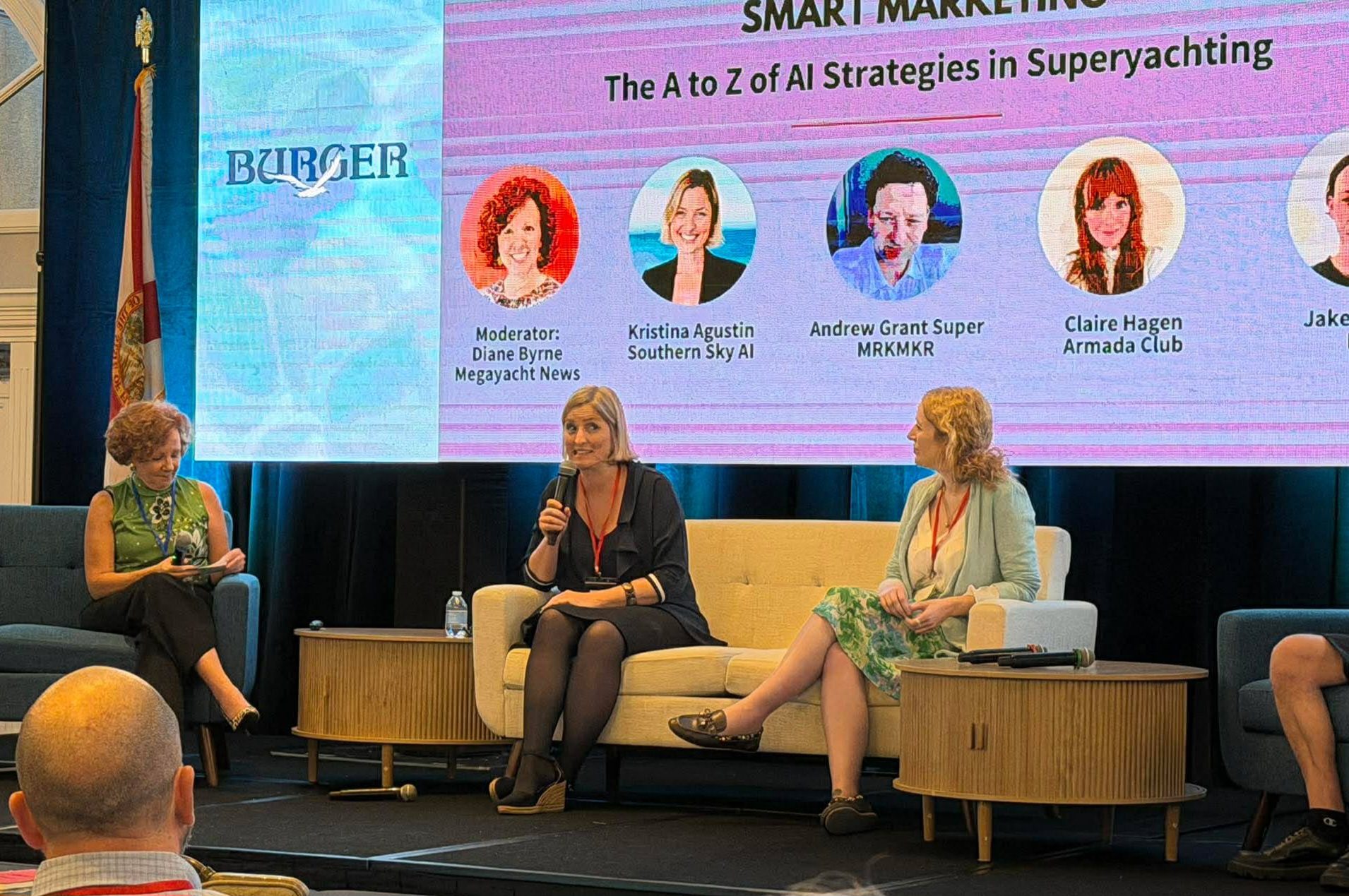
Kristina Agustin, Founder and Principal of Southern Sky AI

Written from inside your world

Kristina Agustin

Founder & Principal Digital Navigator, Southern Sky AI

20+ years in international superyacht and maritime operations. Legally trained (LLB, Graduate Diploma of Legal Practice). AI educator and consultant. ATSE Elevate Scholar 2026.

About Southern Sky AI

Questions

Questions we hear

The central policy sets the requirement; meeting it takes local artifacts your office holds: a use-case inventory that is true, an approved-tools register, training records, risk assessments in the framework you are measured against, and records discipline that survives an audit or a records request. The engagement builds those instruments with you and your office operates them. Nothing here substitutes for the memoranda's own accountabilities, which stay with your Chief AI Officer and accountable officials.

Start with where you stand.

The AI Baseline Report reads your position in about five minutes, and your answers pre-fill everything that follows.

Run the Baseline

Already know where you stand? Governance Essentials puts your position in writing inside 30 days.