Industries · Aquaculture & Fishing

AI for Australian aquaculture and commercial fishing.

The feed system already decides when the fish eat, the Commonwealth's fisheries monitoring is learning to read footage by machine, and the licence, the audit and the export listing all run on your records: the part you control is how each record is made.

The season already asks a great deal of you. AMSA rewrote the safety system requirements in June 2025, the EPA wants the benthic data, the surveillance audit arrives in spring, and the export listing rules changed underneath the market. Somewhere between the feed barge and the licence renewal, AI arrived in the operation: the feed system decides when the fish eat, the cameras estimate biomass, and someone in the office drafts the incident report in a chatbot because the deadline was four o'clock.

The record so far

221obligations

tracked across 25 jurisdictions

  • Every founding document reviewed by the legally trained founder before delivery.

  • Documents usually within two business days.

  • Training certificates independently verifiable at southernsky.ai/verify.

Start Here

Read your operation's position in about five minutes. Twenty plain questions in, four things back: the kinds of AI risk as they reach your operation, the regulations that already apply to you, the cost of leaving that use unmanaged, and the moves that matter most, ranked from the top.

Get your baseline

Where this sits for you

The pressures in your world

Any of those records may one day be read by a regulator, a certifier, an insurer or a journalist, and the reading will turn on a single question: where did a person check the machine's work before it left the building? A written AI position answers that question in advance. It sits beside your SMS, it costs less than your survey, and it holds when the scrutiny comes.

  1. Records may be read in public later

    AUS

    Right-to-information requests, Senate inquiries and campaign groups can reach incident reports, monitoring data and correspondence, and 2025 put the sector on front pages again. Documentation here is written for scrutiny, and an AI-drafted incident report that went out unreviewed is precisely the artifact that fails that test.

  2. Seven regulators, and the surface keeps shifting

    AUS

    The same operation answers the maritime safety regulator (AMSA in Australia), the fisheries regulator, the environmental regulator, biosecurity authorities, export registration, food safety and private certifiers whose audits carry commercial force. Licence breaches carry corporate fines up to $159,000, and each regulator changed something within the last two years, so the compliance surface rarely settles.

  3. One event can stop production entirely

    AUS

    The 2025 South Australian algal bloom closed growing and harvest areas, with 99 percent of surveyed fishers reporting lost income averaging a 40 percent downturn; white spot disease closed prawn farms for nearly two years. When an event hits, you become the full-time interface to emergency regulation, grant paperwork and insurer correspondence.

  4. Boats tied up for want of crew

    AUS

    The labour shortage touches 48 percent of seafood businesses, vessels sit alongside because minimum crewing cannot be met, and mining pays more for easier rosters. Whoever remains in the admin chair automates informally with whatever tool shrinks the reporting mountain, and the senior oversight of how is thin.

  5. Margins move only through volume and efficiency

    AUS

    ABARES projects flat real sector value to 2028-29 while feed, fuel, freight and wages keep rising. Feed is the largest single cost in salmon farming, and AI already makes continuous spend decisions on that line at the corporates, which means the sector's biggest cost is already machine-managed ahead of any written position on it.

  6. The regulator's reading is going machine-assisted

    AUS

    AFMA, the Commonwealth fisheries regulator, is investing in artificial intelligence and machine learning to review electronic-monitoring footage as camera coverage extends across Commonwealth fisheries, and the footage is audited against the logbook. The two records have to agree, and machine-assisted review surfaces a mismatch sooner than it used to.

  7. The review and the levy conversation

    AUS

    An independent review of domestic commercial vessel safety legislation and cost-recovery arrangements is live, and the no-levy grace period that opened the national system has operators expecting charges to follow. The paperwork that proves an operation runs well is the same file either way, and it is growing.

Documented Work

From the Log Book

AI Training

3 role-based workshop days, designed from a 12-department audit · 18 people certified, from maintenance and marine to finance and the executive team · Every participant left with a working AI setup and a reusable Skill built on a real task from their own role · Weeks later, reported publicly by the client: the team using AI more, sharing wins, and a real shift in the day to day

Eighteen people, ten departments, one shared standard for how AI gets used across the organisation.

A twelve-department audit produced three role-based workshop days that certified eighteen people across ten departments, with the CHART quality method and the data rule embedded across the team and every certificate carrying a public verification page.

Read full engagement
AI Training

One-day executive foundation session, delivered one-on-one, designed around a tightly controlled corporate IT environment where every tool runs in the browser · A monthly management accounting and insurer reporting workflow, sixteen reports each month, run end to end through the CHART quality method and captured as a reusable skill · A take-home toolkit and a short explainer video, so everything built on the day stays usable after it

A regulated insurance business, and AI capability built one executive at a time.

A one-day, one-on-one foundation session with a senior executive in the marine insurance sector: a governed AI platform with a commercial data agreement behind it, a working environment built from the executive's own context, and a monthly reporting workflow of sixteen insurer reports run end to end and captured as a reusable skill.

Read full engagement

The Opportunity

What AI is already doing

AI already runs the production layer of Australian seafood: remote feed centres respond to fish behaviour automatically, cameras estimate biomass, and the regulator's own evidence chain is heading the same way, with AFMA, the Commonwealth fisheries regulator, investing in machine learning to review monitoring footage on its side of the table. When the regulator reads records with a machine, the question of how the operator's records were produced follows naturally.

Under a written position, AI already does defined work across the operation, each task with a named checkpoint before a record leaves the building, which is what keeps the operator's side of the evidence as disciplined as the regulator's.


Export documentation

AUS

AI drafts the export declarations that run through DAFF and NEXDOC, which keeps product moving under changing listing rules, and a named checkpoint confirms it before it leaves the operation.

Incident-report first drafts

AI drafts the incident report that goes to two or three regulators at once from the operator's notes, which gets a fast draft under a four o'clock deadline, and a named person checks it against the event before any version is filed.

Feed and biomass summaries

AI summarises feed-conversion and biomass data from the farm software into the evidence the certifier and the EPA expect, which builds the certifier file as the season runs, and the manager confirms the figures against the source before the audit.

Licence and grant correspondence

AI drafts licence correspondence and grant-application text during an emergency-regulation period, which lightens the paperwork when an event hits, and a person reviews it against the licence conditions before it is sent.

Environmental-review drafting

AI drafts the annual environmental review from the monitoring data, which turns the monitoring record into a submission faster, and the manager checks each figure against the benthic record before it goes to the regulator.

These are the workflows the prompt library and the training stand up, under the standard the documents set.

Where to start

Where to start, and where it leads.

  1. AI Baseline

    See what AI could do for your organisation. The AI Baseline Report takes twenty questions and about five minutes, and reads back the use cases returning hours in organisations like yours, the rules that already apply to you, and the moves that matter most, ranked from the top.

  2. Training day

    The office and supervisors to one standard, certificates verifiable at southernsky.ai/verify.

  3. Governance Essentials

    The written AI position: use policy, approved-tools register, named checkpoints before AI-touched records reach a regulator, certifier or insurer, with 90 days of keep-current and team education included, a prompt library that starts the first governed workflow in the office, a recorded briefing, a 30-minute walkthrough call and 30 days of email support. USD $690 founding, then USD $990.

  4. Blueprint

    The corporate-level position that joins production AI to the compliance record.

The outputs are governance artifacts, drafted for review and adoption inside your own organisation; where legal advice is needed, it belongs with qualified counsel.

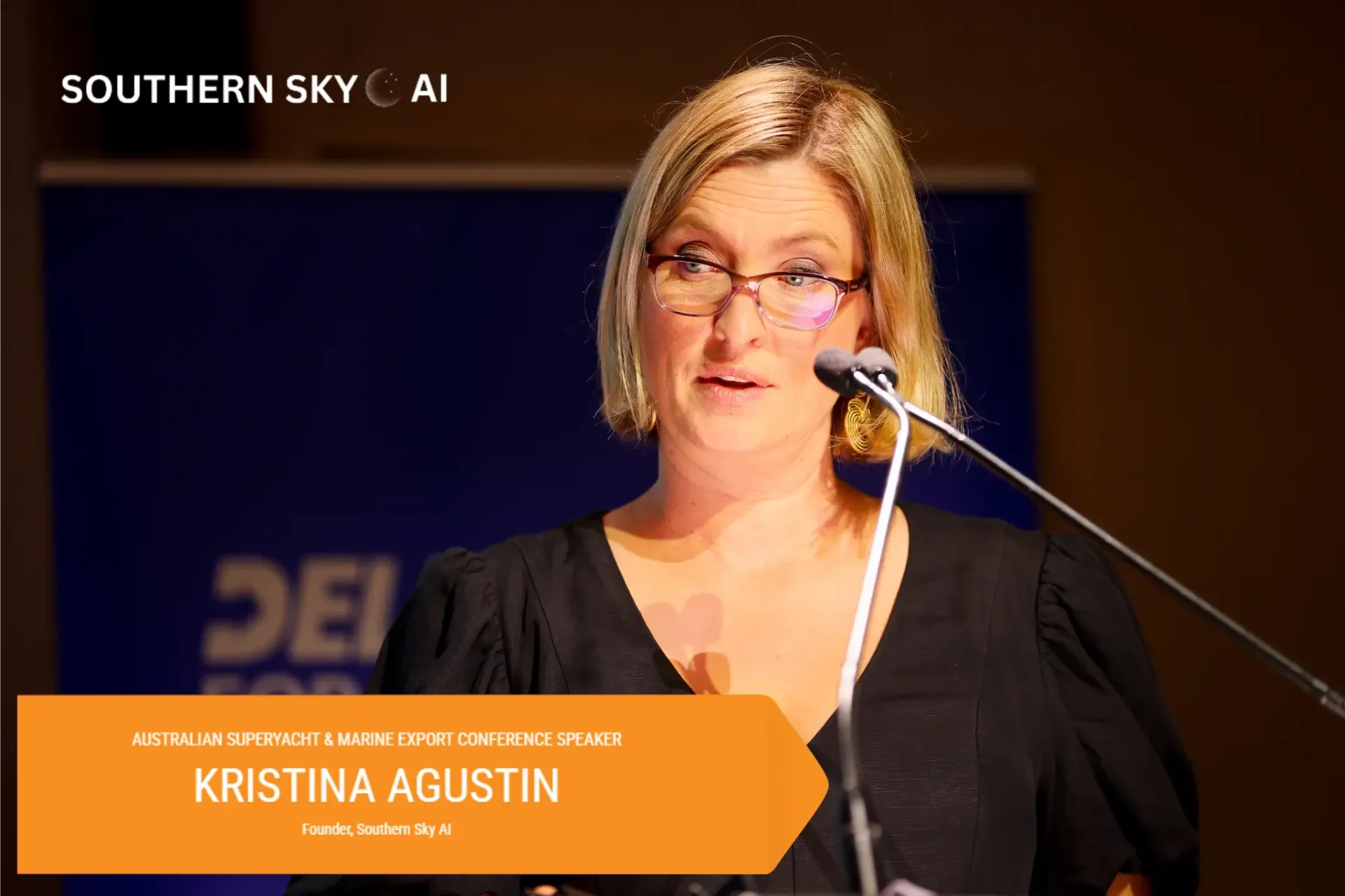
Kristina Agustin, Founder and Principal of Southern Sky AI

Written from inside your world

Kristina Agustin

Founder & Principal Digital Navigator, Southern Sky AI

20+ years in international superyacht and maritime operations. Legally trained (LLB, Graduate Diploma of Legal Practice). AI educator and consultant. ATSE Elevate Scholar 2026.

About Southern Sky AI

Questions

Questions we hear

The obligations stay as they were; the reading of them speeds up. Footage checked against the logbook by machine-assisted review surfaces a mismatch sooner, so the two records have to agree from the first entry. A written position names who checks an AI-touched record before it is filed, which keeps your side of the evidence as disciplined as the regulator's.

Start with where you stand.

The AI Baseline Report reads your position in about five minutes, and your answers pre-fill everything that follows.

Run the Baseline

Already know where you stand? Governance Essentials puts your position in writing inside 30 days.